

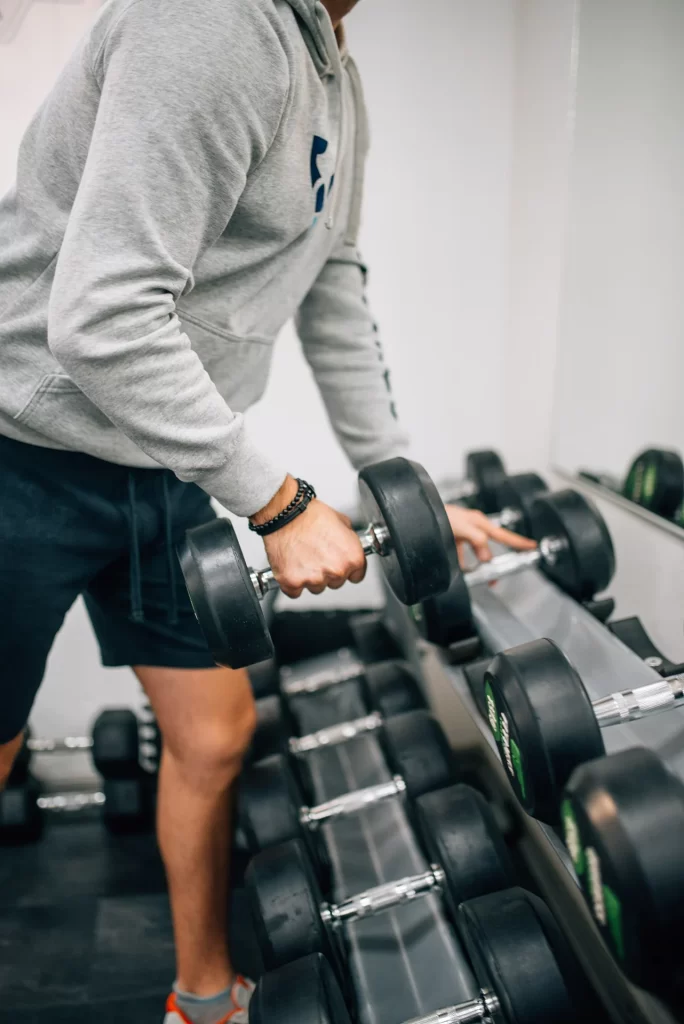
Can you really build muscle without a gym membership? The short answer: absolutely. Your muscles don’t know whether you’re lifting a dumbbell or a backpack full of books — they only respond to resistance. And when it comes to building muscle at home, bodyweight training can take you further than you think, especially as a beginner.
This guide covers everything you need to know: the science of muscle growth, the best home exercises by muscle group, how to structure a weekly routine, nutrition fundamentals, and how to progress as you get stronger.
How Muscle Growth Works: The Basics
Before diving into exercises, it helps to understand what actually makes muscles grow. There are three key mechanisms:
- Mechanical tension: When muscles work against resistance, muscle fibers experience tension. This triggers a biological cascade that leads to growth.
- Muscle damage: Exercise creates microscopic tears in muscle fibers. During recovery, the body repairs these tears, making the fibers thicker and stronger than before.
- Metabolic stress: The “burn” you feel during high-rep sets is metabolic stress. It contributes to growth by increasing the recruitment of muscle fibers and triggering hormonal responses.
The golden rule of muscle building is progressive overload: gradually increasing the demands on your muscles over time. In a gym, you’d add weight to the barbell. At home, you progress by:
- Adding more reps or sets
- Slowing down the movement (increasing time under tension)
- Using harder exercise variations
- Reducing rest time between sets
- Using household items for added resistance
The Best Home Exercises by Muscle Group
You don’t need dozens of exercises. A handful of compound movements — exercises that work multiple muscle groups simultaneously — will give you the best results. Here are the most effective bodyweight exercises for each area.
Chest and Triceps: Push-Ups
The push-up is the king of upper body bodyweight exercises. It targets your chest (pectorals), front shoulders (anterior deltoids), and triceps. Best of all, it has endless variations to match your fitness level.
Beginner: Wall push-ups → Knee push-ups → Incline push-ups (hands on a bench or chair)
Intermediate: Standard push-ups, diamond push-ups (hands close together to target triceps)
Advanced: Decline push-ups (feet elevated), Archer push-ups, one-arm push-ups
Back and Biceps: Pull-Ups and Rows
The back is the hardest muscle group to train at home without equipment. But it’s not impossible.
If you have a pull-up bar: Pull-ups and chin-ups are the gold standard for upper body strength. They target your lats, biceps, and upper back.
If you don’t have a bar: Use a sturdy table for inverted rows (lie under the table, grab the edge, and pull your chest up). You can also use a towel around a door handle for single-arm rows, or fill a backpack with books and do bent-over rows.
Legs: Squats and Lunges
The legs contain the largest muscle groups in the body, making leg training crucial for overall muscle development and metabolic boost.
Beginner: Bodyweight squats, reverse lunges, glute bridges
Intermediate: Bulgarian split squats (one foot on a chair), jump squats, walking lunges
Advanced: Pistol squats (single-leg squats), shrimp squats, jump lunges
Core: Planks and Hollow Body Holds
Forget sit-ups. Isometric core exercises build functional strength without the spine stress.
Key exercises: Forearm plank, side plank, hollow body hold, L-sit (advanced), and leg raises lying on the floor.
Shoulders: Pike Push-Ups
Shoulders are often neglected at home, but pike push-ups solve this. Get into an inverted V shape (hips high, hands and feet on the floor), then lower your head toward the floor between your hands. This directly targets the deltoids. Elevate your feet on a chair for a harder variation that approaches a handstand push-up.
Structuring Your Weekly Routine
For beginners, a full-body routine 3 days per week is the most effective approach. It gives you enough training frequency to stimulate muscle growth while allowing adequate recovery between sessions.
Here’s a sample weekly schedule:
| Day | Focus |
|---|---|
| Monday | Full-body workout A |
| Tuesday | Rest or light walk |
| Wednesday | Full-body workout B |
| Thursday | Rest or light walk |
| Friday | Full-body workout A (slightly harder) |
| Saturday | Active recovery (walk, stretch, yoga) |
| Sunday | Rest |
Workout A
- Push-ups: 3 sets of 8-15 reps
- Bodyweight squats: 3 sets of 12-20 reps
- Inverted rows or pull-ups: 3 sets of 5-10 reps
- Pike push-ups: 3 sets of 6-12 reps
- Plank hold: 3 sets of 30-60 seconds
Rest 60-90 seconds between sets. Aim to add one rep to each exercise each week.
Workout B
- Diamond push-ups: 3 sets of 6-12 reps
- Bulgarian split squats: 3 sets of 8-12 per leg
- Inverted rows (narrow grip): 3 sets of 8-12 reps
- Reverse lunges: 3 sets of 10-15 per leg
- Side plank: 3 sets of 20-40 seconds per side
Alternate between Workout A and B each session. This gives each muscle group slightly different stimuli while maintaining overall balance.
Nutrition: Fueling Muscle Growth
You can’t build muscle from thin air. Nutrition accounts for at least 50% of your results. Here are the fundamentals:
Protein: The Building Block
Research suggests that for muscle growth, you should aim for 0.7-1.0 grams of protein per pound of body weight per day (1.6-2.2g per kg). For a 160 lb man, that’s 112-160 grams of protein daily.
High-protein foods: chicken breast, eggs, Greek yogurt, cottage cheese, lean beef, tuna, lentils, and whey protein powder if you use supplements.
Calories: You Need a Surplus
To build muscle, you need to eat slightly more calories than you burn. A modest surplus of 250-500 calories above your maintenance level is enough. Eating way more won’t build muscle faster — it’ll just add fat.
Carbs and Fats Matter Too
Carbohydrates fuel your workouts and replenish glycogen stores. Fats support hormone production, including testosterone. Don’t eliminate either macronutrient. A balanced split of roughly 40% carbs, 30% protein, and 30% fat works well for most men.
Recovery: When Muscle Growth Actually Happens
Here’s something that surprises many beginners: muscles don’t grow during the workout — they grow during recovery. The workout is just the stimulus. The actual growth happens when you rest, eat, and sleep.
Sleep
Most muscle repair happens during deep sleep, when your body releases growth hormone. Aim for 7-9 hours per night. If you’re consistently getting less than 6 hours, you’re significantly impairing your muscle-building potential.
Rest Days
Don’t train the same muscle group two days in a row. The 48 hours between sessions gives your muscles time to repair and grow. This is why the 3-day-per-week full-body schedule has rest days built in.
How to Track Progress
When you’re not lifting weights, tracking progress can feel tricky. But there are several reliable ways:
- Rep and set tracking: Write down how many reps you did for each exercise. Next week, try to beat it.
- Photos: Take progress photos every 2 weeks in the same lighting and pose. Changes are gradual, and photos make them visible.
- Tape measurements: Measure your chest, arms, waist, and thighs every 2 weeks. This is more reliable than the scale, since muscle weighs more than fat.
- Exercise progression: Moving from knee push-ups to standard push-ups, or from standard to decline, is a clear sign of improvement.
When to Add Equipment
Bodyweight training can take you far, but eventually you’ll want to add resistance. Here’s what to invest in, in order of priority:
- Pull-up bar (doorway): $20-30, unlocks the most effective back exercise you can do at home.
- Resistance bands: $15-25 for a set. Versatile for rows, curls, shoulder work, and assisted pull-ups.
- Adjustable dumbbells: $200-400. Not cheap, but replaces an entire rack of weights. Opens up hundreds of new exercises. Whether they beat a gym membership is a payback question with an answer: at three sessions a week a $219 set pays for itself in about eleven months against a $20 monthly fee. The cost per use calculator runs it with your own numbers.
- Kettlebell: $30-50 for a 16kg bell. Great for swings, goblet squats, and conditioning.
Common Beginner Mistakes
1. Program-hopping: Switching routines every week prevents progressive overload. Pick one program and stick with it for at least 8 weeks.
2. Ignoring nutrition: You can do the perfect workout and still not build muscle if your protein and calorie intake are too low.
3. Training too often: More isn’t better. Three quality sessions per week will outperform six mediocre ones.
4. Skipping leg day: Leg training boosts overall muscle mass, improves hormone response, and prevents the “chicken legs” look. Don’t skip it.
5. Comparing to others: Social media is full of people who’ve been training for years (or have pharmaceutical assistance). Your only competition is who you were last week.
Where Home Training Fails
It fails when progression stops. Bodyweight work only builds muscle while the difficulty keeps rising: more reps, slower tempo, shorter rest, harder variations.
It fails again when sessions become occasional. Three repeatable sessions a week for a year beats a perfect plan run whenever motivation shows up.
If three times a week is still a guess, the training frequency guide sets the number by goal rather than by feel.
This content is for informational purposes only and does not constitute medical advice. Always consult a healthcare professional before starting any exercise or nutrition program. If you experience pain or discomfort during exercise, stop and seek medical guidance.
Photo: Nenad Stojkovic, CC BY 2.0, via Wikimedia Commons
Brand new to this. The Monday/Wednesday/Friday full-body schedule looks doable, but for Workout B it says diamond push-ups at 6-12 reps — if I can only hit 3, should I drop to wall push-ups until I build up, or just do as many as I can?
Been running a 3x/week full-body for about 4 months after years of gym-only training. The Bulgarian split squats took my legs by surprise — bodyweight only and they still hit harder than I expected. One thing that kept me honest: the 2-week progress photos. Day to day you won’t notice, but side by side you do.
Started as a complete beginner in mid-June. Followed the 3-day schedule almost exactly and my push-ups went from 5 to 22. The ’48 hours between sessions’ advice is real — I tried adding a 4th day and got worse, not better.
Great progress on the push-ups — that’s the 3x/week consistency doing its job. And you’re right about the 4th day; more volume only helps once recovery is nailed.
The sleep point hits home. I was stuck around 5.5 hours a night wondering why nothing moved for two months — turns out the workouts weren’t the problem.