

If you want to build real strength — not just “gym muscles” but functional, full-body power — you need to focus on compound exercises. Unlike isolation exercises (like bicep curls) that work one muscle at a time, compound exercises engage multiple muscle groups simultaneously. They give you more results in less time, burn more calories, and translate better to real-world activities.
Here are the 7 best compound movements that should form the backbone of any strength program, whether you train at a gym or at home.
1. The Squat
Muscles Worked
Quadriceps, hamstrings, glutes, core, and lower back. The squat is often called the “king of exercises” because it engages the largest muscle groups in the body.
How to Perform
Stand with feet shoulder-width apart, toes slightly turned out. Brace your core. Push your hips back and bend your knees as if sitting into a chair. Descend until your thighs are at least parallel to the floor (or as low as your mobility allows). Drive through your heels and push the floor away to stand back up.
Why It’s Essential
The squat builds lower body strength, improves hip mobility, and stimulates the largest release of muscle-building hormones of any exercise. It’s also a movement you perform dozens of times daily — every time you sit down and stand up.
Progression Path
Bodyweight squats → Goblet squats (holding a dumbbell or kettlebell at chest) → Split squats → Pistol squats (single-leg). If you have access to a barbell, the back squat and front squat are the gold standards.
2. The Deadlift
Muscles Worked
Hamstrings, glutes, lower back, upper back, forearms, and core. The deadlift works your entire posterior chain — the muscles along the back of your body that are crucial for posture, power, and injury prevention.
How to Perform (with a Barbell or Heavy Object)
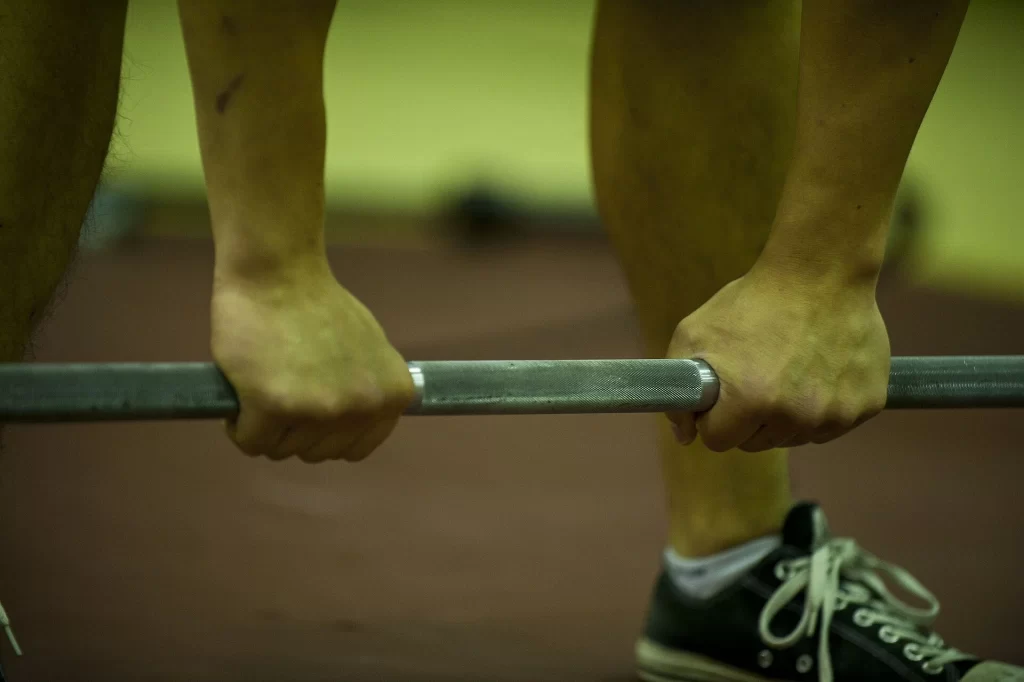
Stand with your feet hip-width apart, with the weight (barbell, dumbbells, or a heavy backpack) over the middle of your feet. Hinge at your hips, keeping your back flat and chest up. Grip the weight. Drive your hips forward and stand up tall, squeezing your glutes at the top. Lower with control by pushing your hips back.
Why It’s Essential
Nothing builds raw, functional strength like the deadlift. It teaches you to safely pick heavy objects off the ground — a skill that protects your back in daily life. It also builds the posterior chain that most men neglect (thanks to sitting at desks all day).
At-Home Alternative
The single-leg Romanian deadlift (bodyweight or with a light dumbbell) is an excellent home alternative. It builds balance, hamstring flexibility, and posterior chain strength with minimal equipment.
3. The Push-Up
Muscles Worked
Chest (pectorals), front shoulders (anterior deltoids), triceps, and core (as a stabilizer). The push-up is the most accessible upper body compound exercise — you can do it anywhere.
How to Perform
Start in a plank position with hands slightly wider than shoulder-width. Your body should form a straight line from head to heels. Lower your chest toward the floor by bending your elbows at a 45-degree angle to your torso. When your chest is about an inch from the floor, push explosively back up to the starting position.
Why It’s Essential
The push-up is endlessly scalable. A beginner can start with wall push-ups and progress all the way to one-arm push-ups. It also doubles as a core exercise — holding a plank position under load builds abdominal strength that crunches never will.
Variations Worth Mastering
- Diamond push-ups: Hands close together — targets triceps and inner chest
- Decline push-ups: Feet elevated — shifts emphasis to upper chest and shoulders
- Archer push-ups: One arm straight, one bent — bridges the gap to one-arm push-ups
- Plyometric push-ups: Push up explosively with hands leaving the floor — builds power
4. The Pull-Up
Muscles Worked
Latissimus dorsi (lats), biceps, upper back (rhomboids and trapezius), and forearms. The pull-up is the gold standard for upper body pulling strength.
How to Perform
Hang from a bar with hands slightly wider than shoulder-width, palms facing away (pull-up) or toward you (chin-up). Engage your back muscles by pulling your shoulder blades down and back. Pull your chin above the bar. Lower with control — don’t just drop. The eccentric (lowering) phase is where much of the strength building happens.
Why It’s Essential
Pull-ups build the V-taper look that most men want — wide lats that create the illusion of a smaller waist. They also counteract the rounding-forward posture that comes from desk work and excessive pushing exercises. If you can’t do a single pull-up yet, start with negative pull-ups (jump to the top, lower slowly) and inverted rows.
5. The Overhead Press
Muscles Worked
Shoulders (all three deltoid heads, especially the front and lateral), triceps, upper chest, and core (for stabilization).
How to Perform
With dumbbells or a barbell: Start with the weight at shoulder height, palms facing forward. Brace your core and squeeze your glutes (this protects your lower back). Press the weight overhead until your arms are fully extended. Lower with control to the starting position.
At-Home Alternative: Pike Push-Ups
Get into an inverted V position (hips high, like a downward dog in yoga). Lower your head toward the floor between your hands, then press back up. Elevate your feet on a chair to increase the difficulty and shift more weight onto your shoulders.
Why It’s Essential
Strong shoulders improve posture, make everyday tasks easier (reaching overhead, lifting things onto high shelves), and give you a more athletic appearance. The overhead press also engages the core more than people realize — stabilizing a weight overhead requires serious abdominal strength.
6. The Bent-Over Row
Muscles Worked
Upper back (lats, rhomboids, trapezius), biceps, rear shoulders (posterior deltoids), and forearms. The row is the horizontal pulling counterpart to the vertical pull-up.
How to Perform
With dumbbells or a barbell: Hinge forward at your hips, keeping your back flat and chest up (torso about 45-60 degrees from vertical). Let the weight hang with arms extended. Squeeze your shoulder blades together and pull the weight toward your lower ribcage. Lower with control.
At-Home Alternative: Inverted Rows
Lie under a sturdy table, grab the edge with both hands (or use a broomstick across two chairs). Hang with your body straight and heels on the floor. Pull your chest toward the table edge. Adjust difficulty by changing your body angle — more horizontal = harder, more upright = easier.
Why It’s Essential
Rows are critical for back health and posture. They strengthen the muscles that pull your shoulders back — counteracting the rounded-shoulder posture most men develop from desk work and phone use. Pair every push-up with a row to keep your shoulders balanced.
7. The Lunge
Muscles Worked
Quadriceps, hamstrings, glutes, and calves. The lunge also challenges balance, coordination, and hip mobility — qualities that bilateral (two-legged) exercises don’t address as effectively.
How to Perform
Stand tall. Take a large step forward. Lower your hips until both knees are at 90-degree angles (front knee over the ankle, back knee hovering just above the floor). Push through the front heel to return to the starting position. Alternate legs.
Variations
- Reverse lunges: Step backward instead of forward — easier on the knees, better for beginners
- Walking lunges: Step forward continuously — great for conditioning and muscle endurance
- Bulgarian split squats: Rear foot elevated on a bench or chair — increases range of motion and glute activation
- Jump lunges: Explosive switch between legs — builds power and elevates heart rate
Why It’s Essential
Unilateral (single-leg) exercises like the lunge correct strength imbalances between your left and right sides. Most people have one dominant leg — lunges force each side to work independently, preventing the stronger leg from compensating. They also improve balance and proprioception, reducing injury risk in daily life.
How to Combine These Into a Workout
Here’s a simple full-body workout using all 7 movements. Do this 3 days per week (e.g., Monday, Wednesday, Friday), resting 60-90 seconds between sets:
- Squats: 3 sets of 10-15 reps
- Push-ups: 3 sets of 8-15 reps
- Inverted rows or pull-ups: 3 sets of 6-12 reps
- Lunges: 3 sets of 8-12 per leg
- Pike push-ups or overhead press: 3 sets of 8-12 reps
- Single-leg Romanian deadlifts: 3 sets of 8-12 per leg
- Plank hold: 3 sets of 30-60 seconds
This hits every major muscle group, in every movement pattern (push, pull, squat, hinge, lunge, carry). That’s the beauty of compound exercises — 7 movements, full-body coverage.
The Principle That Ties Them Together
All 7 exercises share one thing: they’re functional movement patterns, not muscle isolation exercises. Your body is designed to push, pull, squat, hinge, and lunge. Training these patterns makes you stronger in the way your body was meant to move — whether you’re lifting a child, carrying groceries, moving furniture, or playing sports.
Isolation exercises have their place (for rehabilitation or targeting weak points), but compound movements should make up 80% or more of your training. Master these 7, progress them gradually, and you’ll build strength that matters — not just in the gym, but in life.
This content is for informational purposes only and does not constitute medical advice. Always consult a healthcare professional before starting any exercise program. Stop immediately if you experience pain, and seek qualified instruction for complex movements like the deadlift.
Solid list. I train at home with just a pull-up bar and adjustable dumbbells — looks like I can cover most of the 7 (inverted rows instead of barbell rows, dumbbell lunges, goblet squats). Which one would you say is the hardest to replace without a barbell? The hip hinge feels like the weak link for me.
The 80% compound rule is the advice I wish someone gave me ten years ago. I spent two years on mostly machine isolation work, then switched to this style of programming and my lifts went up across the board within a few months. The 45-degree elbow cue on push-ups alone cleaned up my shoulder pain.
Three sets of the 7-movement full-body circuit on Mon/Wed/Fri and I’m finally not overthinking my training. Functional patterns over isolation is the takeaway here.
Only pushback I’d offer: if you’re coming back from an injury (rotator cuff, lower back), the ‘just do the compounds’ advice can be a trap — I needed two months of isolation rehab before I could hinge safely again. Worth a caveat for beginners.