

You’ve been training for months. You show up, lift the weights, drink the protein shake. But when you look in the mirror, nothing has changed. The scale hasn’t moved. Your shirts fit the same. What’s going on?
Building muscle isn’t complicated, but it’s also not automatic. Showing up to the gym is only step one. If you’re not seeing results, you’re almost certainly making one (or more) of these 10 common mistakes. Let’s identify and fix them.
Mistake 1: You’re Not Eating Enough
This is the #1 reason men fail to build muscle. You can train perfectly, but if you’re not in a caloric surplus — eating more calories than you burn — your body simply doesn’t have the raw materials to build new muscle tissue.
Think of it like building a house. Exercise is the blueprint that tells your body what to build. Food is the bricks. You can have the best blueprint in the world, but without bricks, nothing gets built.
The fix: Calculate your TDEE (use a free online calculator), add 300-500 calories, and track your intake for at least 2 weeks. Use an app like MyFitnessPal or Cronometer. Most men who “can’t gain muscle” are eating 500-1000 calories less than they think.
Mistake 2: Your Protein Intake Is Too Low
Even if you’re eating enough calories, you might not be eating enough protein. Protein provides the amino acids your body uses to repair and build muscle fibers. Research recommends 0.7-1.0 grams of protein per pound of body weight per day for muscle growth.
For a 160 lb man, that’s 112-160 grams of protein daily. That’s roughly 3-4 chicken breasts, 5-6 eggs, or 3-4 scoops of protein powder — per day. If you’re not tracking, you’re probably falling short.
The fix: Aim for 30-40g of protein per meal across 3-4 meals. Prioritize high-protein foods: eggs, chicken, lean beef, Greek yogurt, cottage cheese, fish, lentils. If you struggle to hit your target, a whey protein shake can fill the gap. Read our full protein guide for details.
Mistake 3: You’re Not Progressively Overloading
If you’re lifting the same weight for the same reps as you were 3 months ago, your muscles have no reason to grow. Muscle growth is a response to increasing demands. No new demands = no new muscle.
The fix: Track every workout. Aim to improve something each session — even if it’s just one more rep or 2.5 more pounds. The progression doesn’t need to be dramatic; it needs to be consistent. Even adding 1 rep per week compounds to 52 reps over a year.
Mistake 4: You’re Doing Too Much Volume
More isn’t better — better is better. If you’re doing 20+ sets per muscle group per session, you’re likely accumulating junk volume: sets where fatigue is so high that the stimulus is minimal. You’re also burning out your recovery capacity.
Research from Brad Schoenfeld and colleagues suggests that 10-20 working sets per muscle group per week is optimal. More than that shows diminishing returns and potentially negative effects on recovery.
The fix: Quality over quantity. Do 6-10 hard, focused sets per muscle group per session, taken within 1-3 reps of failure. Leave a rep or two in the tank on most sets to preserve quality. Train each muscle group 2x per week, totaling 12-20 sets.
Mistake 5: You’re Inconsistent
You train 4 days one week, 1 day the next, skip a week entirely, then train 5 days the following week. Sound familiar? Inconsistency is a muscle-building killer. Your body adapts to the stimulus you provide — and if that stimulus is irregular, the adaptation never happens.
The fix: Pick a frequency you can actually maintain — even if it’s “only” 3 days per week. Three consistent sessions per week for 6 months (72 total workouts) will produce dramatically better results than inconsistent 5-day weeks (40 actual workouts). Consistency is the secret everyone overlooks.
Mistake 6: You’re Not Sleeping Enough
Most muscle repair and growth happens during deep sleep, when your body releases growth hormone and testosterone. A study published in the Journal of the American Medical Association found that reducing sleep from 8 to 5 hours per night for one week reduced testosterone levels by 10-15% in young, healthy men.
Low testosterone directly impairs muscle growth. Poor sleep also increases cortisol (which breaks down muscle) and reduces insulin sensitivity (making it harder to utilize nutrients for growth).
The fix: Aim for 7-9 hours per night. Prioritize sleep the way you prioritize training. Set a bedtime, keep your room dark and cool, and stop looking at screens 30-60 minutes before bed.
Mistake 7: You’re Doing Too Much Cardio
Cardio is good for your heart, but excessive cardio directly competes with muscle growth. This is called the “interference effect.” Long-distance running and high-volume cardio create adaptations that are opposite to muscle growth — your body becomes more efficient (burning fewer calories) rather than bigger and stronger.
The fix: If your primary goal is muscle, limit cardio to 2-3 sessions per week, 20-30 minutes each. Prefer walking, cycling, or rowing over running. If you want to do more cardio, separate it from lifting by at least 6 hours, or do it on rest days.
Mistake 8: Your Form Is Sloppy
Using momentum, bouncing weights, shortening range of motion, and letting your ego choose the weight — these are all symptoms of poor form. Sloppy reps don’t fully stimulate the target muscles and increase injury risk. When you get hurt, you miss training time — and missed training means no growth.
The fix: Check your ego at the door. Use a weight you can control through the full range of motion. If you can’t pause for 1 second at the hardest position, the weight is too heavy. Record yourself and compare your form to instructional videos from reputable sources.
Mistake 9: You’re Not Tracking Progress
How much did you bench press 4 weeks ago? How many reps? If you don’t know, you can’t tell if you’re progressing. Men who don’t track often think they’re not making progress even when they are — or worse, they think they’re progressing when they’ve actually plateaued.
The fix: Keep a training log. Write down the date, exercise, weight, sets, and reps for every session. Review it monthly. If the numbers are going up, you’re building muscle — even if the mirror hasn’t caught up yet. If the numbers aren’t moving, you know exactly what to fix.
Mistake 10: You Have Unrealistic Expectations
Social media has warped our perception of what’s achievable. The guys on Instagram with 20-inch arms and 6% body fat have been training for 10+ years, use performance-enhancing drugs, and have perfect lighting, angles, and filters.
In reality, a beginner can expect to build about 1-2 lbs of muscle per month in the first year. That’s 12-24 lbs of muscle in year one — a dramatic transformation. But month to month, the changes are subtle.
The fix: Take progress photos every 2 weeks in the same lighting and pose. Measure your arms, chest, waist, and thighs monthly. Trust the process. Muscle growth is slow but it’s real — and unlike fat loss, the results are permanent as long as you keep training.
Bonus: Are You Actually Training Hard Enough?
There’s one more mistake that’s uncomfortable to acknowledge: you might not be training hard enough. Many men stop their sets well before they reach true failure — the point where you physically cannot complete another rep with good form.
Research from Stewart and colleagues found that most people stop 3-5 reps short of actual failure. They think they’re at failure when they still have several reps left. If you want to maximize muscle growth, your working sets should be within 1-3 reps of failure.
The fix: On your last set of each exercise, ask yourself: “Could I have done 3 more reps?” If the answer is yes, you stopped too early. Push closer to failure — safely, with good form — on your final set. This is where the most growth stimulus occurs.
The Checklist: Fix Your Gains Today
- ☐ Am I eating 300-500 calories above maintenance?
- ☐ Am I eating 0.8-1.0g protein per pound of body weight?
- ☐ Am I adding weight or reps each week?
- ☐ Am I doing 12-20 total sets per muscle group per week?
- ☐ Am I training consistently (at least 3x per week, every week)?
- ☐ Am I sleeping 7-9 hours per night?
- ☐ Is my cardio limited to 2-3 sessions, 30 min each?
- ☐ Is my form clean through full range of motion?
- ☐ Am I tracking every workout?
- ☐ Am I taking sets close enough to failure?
If you answered “no” to any of these, that’s your starting point. Fix one thing at a time — don’t try to change everything at once. Address the biggest gap first, master it for 2 weeks, then move to the next. In 8-12 weeks, you’ll be unrecognizable.
This content is for informational purposes only and does not constitute medical advice. Always consult a healthcare professional before starting any exercise or nutrition program.
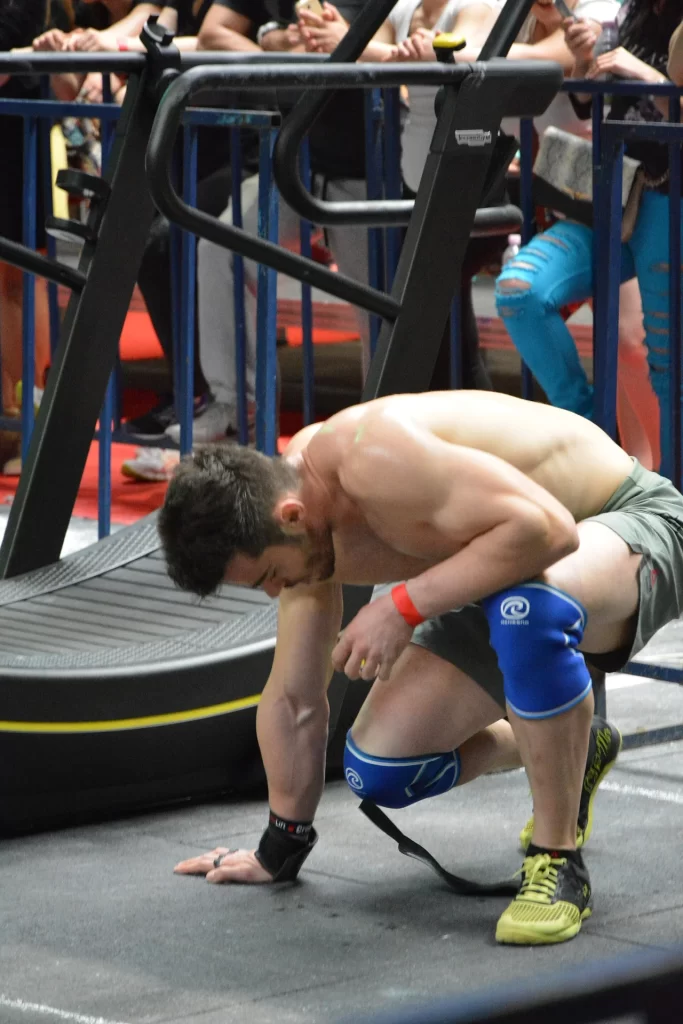
Photo: Robertgombos, CC BY-SA 4.0, via Wikimedia Commons
Mistake 1 hit hard — I’ve been ‘eating a lot’ and training hard for 8 months with maybe 2kg to show for it. Tracked for a week and I’m at roughly 2200 calories when I thought I was at 2800. The 300-500 surplus advice means I’m probably 600-800 short most days.
Can second the progressive overload point from the other direction — I spent a year adding reps instead of weight, and 20-rep sets just built endurance. Logging every session and adding 2.5kg when I hit the top of the rep range is what finally kicked growth back in.
Fixing the per-meal protein (30-40g across 4 meals) plus the surplus finally broke my plateau after two stagnant years. Six months later I’m up about 5kg with the same waist measurement. Tracking for those first 2 weeks was the unlock.
Printing mistake 3 and taping it to my squat rack. Same weight for months is exactly what I’ve been doing.