

Chinos vs jeans comes down to what you are counting. Count occasions and chinos win: one pair of navy or khaki chinos covers more of the places you actually go. Count wear and denim wins: jeans hold their shape past 40 wears while a cotton twill chino starts showing knee bag and seat shine somewhere between 15 and 25. Buy chinos first if you dress for work, dinners and weddings. Buy jeans first if you own one pair of trousers and wash it rarely.
Most comparisons of these two stop at “it depends”. This one counts. Occasions, outfit combinations, laundry loads and five-year condition are all estimated below. The method behind every number sits next to it, so you can redo the arithmetic against your own wardrobe.
Occasion Count: Chinos Cover 10 of 11, Jeans Cover 8
Start with the occasions where a man in his twenties to forties needs trousers and the setting carries a dress expectation. Garden work in beaten-up denim does not count as versatility. Being able to wear the same pair two days running does.
| Occasion | Chinos | Jeans |
|---|---|---|
| Job interview | yes | no |
| Client meeting, business casual | yes | no |
| Office under a smart-casual policy | yes | dark, uncuffed, no distressing |
| Daytime wedding | yes | no |
| Evening dinner, mid-range restaurant | yes | dark denim only |
| First date, drinks | yes | yes |
| Saturday errands | yes | yes |
| Bar with friends | yes | yes |
| Concert | yes | yes |
| Travel day | yes | yes, if the denim has stretch |
| Manual work or moving house | no | yes |
Chinos: 10 of 11. Jeans: 8 of 11, and two of those eight are conditionals. The gap is entirely in the formal half of the list. Jeans only lose an occasion when the room expects tailoring, and chinos only lose when the work is dirty.
Outfit Count: The Top Half Decides It
Take a small baseline wardrobe: three white tees, three oxford shirts, two polos, one navy blazer, two knit sweaters. That is 11 tops.
Navy and khaki chinos accept all 11. Indigo denim rejects the blazer in most rooms and fights the light blue oxford under fluorescent light, so it covers about eight. The trousers you own more of should be the ones that accept the tops you own more of, and that is a counting problem, not a taste problem.
The Four Numbers That Separate Them
| Dimension | Chinos | Jeans |
|---|---|---|
| Occasions covered (from the 11 above) | 10 | 8 |
| Tops paired, from an 11-piece top half | 11 | 8 |
| Wash frequency needed | every 2-3 wears | every 8-10 wears |
| Wash loads per year at 3 wears a week | about 62 | about 17 |
| First visible failure | knee bag at 15-25 wears, seat shine at 30-40 | crotch wear at 12-18 months of near-daily wear |
| State after five years of weekly wear | demoted to house and garden duty | faded, softer, still wearable |
How each number was built. Wash frequency follows the care guidance for the two fabrics: cotton twill shows creases and holds odour faster than denim, and denim is traditionally washed far less often. Three wears a week is 156 wears a year, which divides into 62 loads for chinos at 2.5 wears per wash and 17 for jeans at nine wears per wash. Wear life comes from fibre mechanics rather than a test. Chino twill is a lighter cloth, typically 250-300 gsm, against 340-475 gsm for 10-14 oz denim. The lighter cloth loses its shape under repeated knee tension sooner. These are estimates with the assumptions printed on them, not measurements.
Laundry Is Where the Cheaper Pair Costs More
A chino is a laundry item. Denim is not. Between washes, a chino accumulates creases at the lap and a bag at the knee, and you cannot spot-clean that away. A pair of jeans can go a fortnight without looking neglected.
Put a per-load assumption of one dollar against those load counts and one pair of chinos costs roughly $62 a year to keep presentable, against $17 for jeans. That is $45 a year, $225 across five years, which is two or three replacement pairs. The trouser that looks cheaper on the rack is not the cheaper trouser.
One correction to the folklore: the advice to never wash denim is partly marketing. Denim needs washing for hygiene, and cold washing inside out then air drying does the job without wrecking the fade.
Where Denim Wins and the Argument Should Stop
Cold weather, long walks, sitting on the ground, moving furniture, riding anything with two wheels. Denim wins all of them, and it wins by a distance. Heavier cloth blocks wind, resists abrasion, and does not show a fold or a scuff the way a pressed twill does. If your week involves any of that, the count above is answering a question you are not asking.
Fit tolerance is also the quiet argument in the cut debate: our slim vs regular vs relaxed comparison shows where each cut forgives a loose fit and where it punishes one.
Fit Tolerance Is the Difference Nobody Counts
Denim hides. Chinos expose. Dark, heavy cloth conceals a tight thigh, a crease and a mark. Khaki twill in daylight shows all three. If your thighs are large relative to your waist, which is normal for anyone who trains, denim in a straight or relaxed cut is the more forgiving pair. Chinos then need a relaxed straight leg rather than a taper.
Waist sizing compounds it. Denim is sold in waist and inseam, so the fit is precise on two axes. Chinos are usually sold in waist and a fixed inseam, and the cut varies between brands by 2-3 cm at the thigh for the same stated size. That variability is why so many men own chinos that fit at the waist and pull at the pocket.
One more input matters more than either fabric. A clean silhouette from the shoulders up does more for how you are read than the cloth on your legs, and that starts with the haircut rather than the hem.
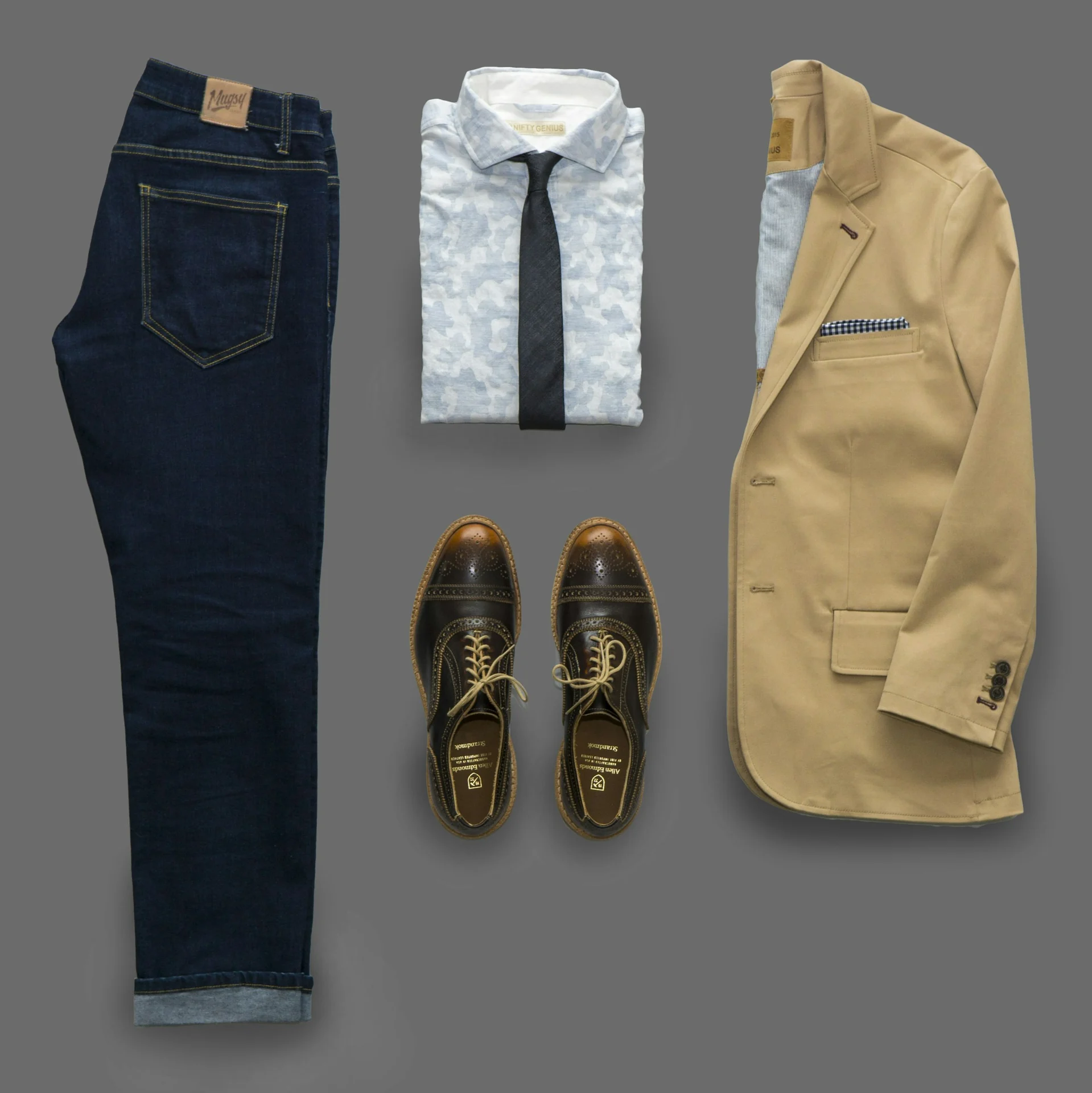
Whichever pair wins, the outfit is usually decided at the ankle: we mapped which shoes go with which outfits for both.
What to Buy, in Order
Buy one pair of chinos first, in navy or a mid khaki, in a straight or slim-straight cut. It covers the 10 occasions that jeans cannot. Add one pair of dark indigo jeans with no distressing and a mid rise. Together they handle 11 of the 11 occasions above, and they cost less than three pairs of either.
On price, stay inside the category range rather than chasing a label. Cotton twill chinos run from about $30 at the low end to $120 for tailored pairs, and denim from about $40 to $200 for raw selvedge. For most men, $60-80 chinos and $70-100 jeans deliver the fabric weight, the seam construction and the cut that matter. Cheap chinos fail first at the pocket bags and the belt loops, so check those two points before you check the colour.
If you want the downgrade path, it still works. A pair of $30 chinos in a straight cut, pressed once, outperforms a $120 pair in a cut that does not suit your thighs. That is also the logic behind keeping to a small minimalist wardrobe instead of buying another pair you will wear monthly.
Two Questions That Decide It for You
Does a 10-to-8 occasion gap matter to me? Add up how often you attend anything in the top half of the occasion table. If it is more than once a month, chinos first. If it is twice a year, buy the jeans and borrow a pair of chinos for the wedding.
Which one will I actually wash? Be honest here. If you know you will not press anything and will not do a 62-load year, jeans are the pair that survives your real routine. The rules for dressing better assume laundry happens. Ignoring that assumption is how wardrobes fill up with clothes nobody wears.
The One Number That Decides It
Chinos cover ten of eleven occasions in the comparison and pair with eleven tops; denim covers eight and survives far longer between washes. The number that decides your first purchase is the count of tops in your wardrobe that work with khaki.
Count them. If that number beats the indigo number, buy the chinos first and add denim later.
Leave a comment
Thanks — your comment is in the queue and will appear once it has been read.